Relationship Between BMI and Age!
The Scales of Time: Understanding the Relationship Between BMI and Age
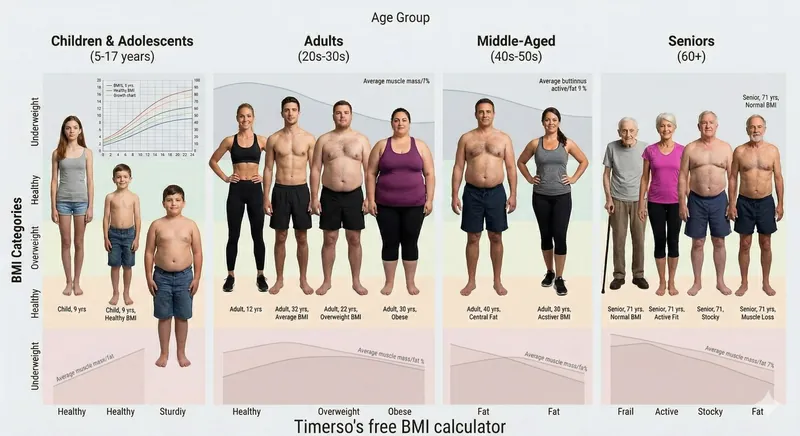
As we journey through different stages of life, our bodies undergo significant physiological changes. One of the most common metrics used to monitor health is the Body Mass Index (BMI). However, many people don't realize that the "ideal" BMI isn't a static number—it often shifts as we age.
In this article, we’ll explore how age influences BMI results and why it’s important to use a tool that accounts for these variables.
What is BMI?
BMI is a simple calculation that uses your height and weight to determine if you are in a healthy weight range. The standard formula is:
BMI = weight (kg) / [height (m)]²
While the formula remains the same regardless of how old you are, the way we interpret the results changes significantly between childhood, adulthood, and the senior years.
BMI in Childhood and Adolescence
For children and teenagers, BMI is not interpreted as a fixed number. Because children grow at different rates and develop muscle and fat differently depending on their sex, BMI is plotted on growth charts. A "healthy" BMI for a 5-year-old is vastly different from a healthy BMI for a 15-year-old.
BMI in Adulthood
For most adults (ages 20–65), the standard categories typically apply: * Underweight: Below 18.5 * Healthy Weight: 18.5 – 24.9 * Overweight: 25.0 – 29.9 * Obese: 30.0 or higher
However, as we age within this bracket, our body composition naturally shifts. We tend to lose lean muscle mass and gain body fat, even if the number on the scale stays exactly the same. This is why staying active is crucial to maintaining a healthy BMI "quality."
BMI in Seniors (65+)
Interestingly, research suggests that for older adults, having a slightly higher BMI might actually be beneficial. While a BMI of 25–27 is considered "overweight" for a young adult, it is often seen as a "protective" range for seniors. A bit of extra weight can provide a nutritional reserve during illness and help prevent bone fractures from falls.
Why You Should Check Your BMI
Understanding your BMI is a great starting point for discussing your health with a doctor. Because age plays such a vital role in how you should view your score, it is helpful to use a calculator that keeps your specific details in mind.
You can use the timerso bmi calculator, which allows users to calculate their BMI based on their age for free.
Why use this tool?
- Age-Specific Context: It helps you see where you stand based on your current stage of life.
- Fast and Free: Get your results instantly without any cost.
- Health Tracking: It serves as a benchmark for your fitness and nutrition goals.
To get started, head over to https://timerso.com/bmi-calculator/ and enter your details today.
Disclaimer: BMI is a screening tool, not a diagnostic one. It does not account for muscle mass, bone density, or overall body composition. Always consult with a healthcare professional before making significant changes to your diet or exercise routine.