Understanding the Korean Age System: Calculation, History, and Recent Changes
If you are a fan of K-dramas, K-pop, or have Korean friends, you have likely run into a confusing scenario: someone states their age, and it turns out to be a year or two older than you expected based on their birth year.
Welcome to the traditional "Korean age" system (한국 나이 - Hanguk nai).
While it might seem like a mathematical puzzle to outsiders, it is a deeply rooted cultural practice with a fascinating history. In this comprehensive guide, we will explore how this traditional system works, where it came from, its impact on Korean society, and the major legal shifts that have recently taken place.
How Does the Korean Age System Work?
In the international age system—which most of the world uses—you are born at zero years old. You add one year to your age on the exact anniversary of your birth.
The traditional Korean age system completely ignores your actual birthday for counting purposes and operates on two main rules:
- You are 1 year old on the day you are born. The time spent inside the womb is roughly counted as the first year of life.
- Everyone ages together on January 1st. Your age increases at the start of the new calendar year, regardless of the month you were born.
This creates interesting edge cases. For instance, if a baby is born on December 31st, they are considered 1 year old. The very next day, on January 1st, they turn 2 years old, even though they have only been in the world for 48 hours!
How to Calculate Your Korean Age
Calculating your traditional Korean age is actually quite simple. Because the month and day of your birth do not matter, you only need to know your birth year and the current year.
The Formula:
(Current Year - Your Birth Year) + 1 = Your Korean Age
Let's look at an example: If you were born in 1998, and the current year is 2026, the math looks like this: (2026 - 1998) + 1 = 29 years old in Korean age.
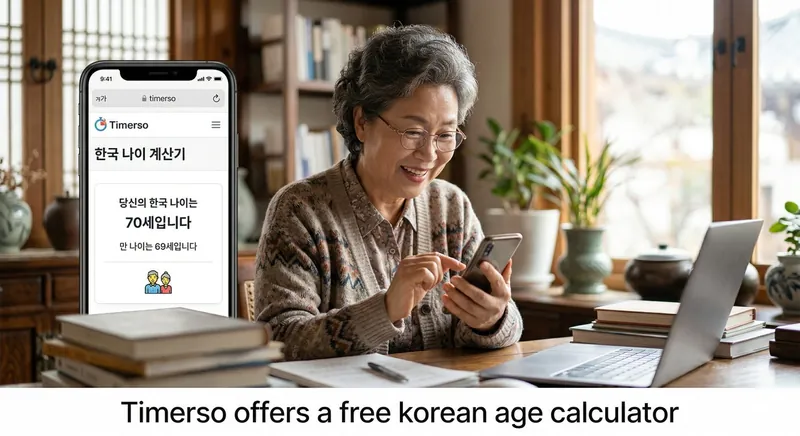
If you want to skip the manual math and get an instant result, you can easily use a free online Korean age calculator to find out your exact traditional age.
The Origins and History
Despite being closely associated with South Korea today, this age-counting method actually originated in ancient China.
In ancient times, the mathematical concept of "zero" had not yet been introduced to East Asia. Counting naturally began at "one." Therefore, the first year of your life was year one.
Additionally, ancient agricultural societies relied on the lunar calendar. Time was tracked by the passing of seasons and the collective changing of the year, rather than hyper-specific individual birthdays. The transition into a new year was a shared milestone where the entire community advanced together.
While China, Japan, and Vietnam historically shared this system, they all modernized and adopted the international age standard during the 19th and 20th centuries. South Korea was the last major country to retain the traditional system in daily life.
Why Did It Stick Around in Korea?
The traditional age system survived in South Korea largely due to the Korean language and the societal structure deeply influenced by Neo-Confucianism.
In Korean society, age establishes a strict social hierarchy. It dictates how you interact, eat, and speak with others. The Korean language has distinct levels of politeness and specific honorific titles based on age relative to the speaker: * Chingu (Friend): If you are born in the same year, you are the same age and can speak casually. * Hyung/Oppa/Nuna/Unni: If someone is born in an earlier year, they are your senior. You must use these respectful titles and polite language forms.
By advancing everyone's age on January 1st, the traditional system creates a clean, indisputable hierarchy for anyone born in the same calendar year. It prevents the social friction of figuring out who is the "senior" if two people are born only a few months apart in the same year.
The Modern Shift: June 2023 Law Change
Having multiple age systems caused significant administrative headaches. Before 2023, South Korea essentially used three systems: 1. Korean Age: For daily life and social interactions. 2. International Age: For medical, legal, and official documents. 3. Calendar Age: For military conscription and the legal drinking/smoking age (calculating age by subtracting birth year from the current year, without adding 1).
To eliminate this confusion, the South Korean government passed a law unifying the country under the international age system, effective June 28, 2023. Officially, all South Koreans became one or two years younger overnight in the eyes of the law!
Is Korean Age Still Used?
Yes. While official documents and legal matters now strictly use international age, cultural habits are deeply ingrained. In casual introductions, many Koreans still default to their traditional Korean age or simply ask, "What year were you born?" to quickly establish the necessary social dynamic.
Final Thoughts
The Korean age system is more than just a quirky way of counting numbers; it is a reflection of East Asian history, linguistic structure, and social respect. While the legal framework has modernized, the cultural footprint of the system remains.
Curious to see where you stand? Head over to the free online Korean age calculator to discover your traditional Korean age today!