Beyond the Scale: Is BMI Enough to Measure Your Overall Health?
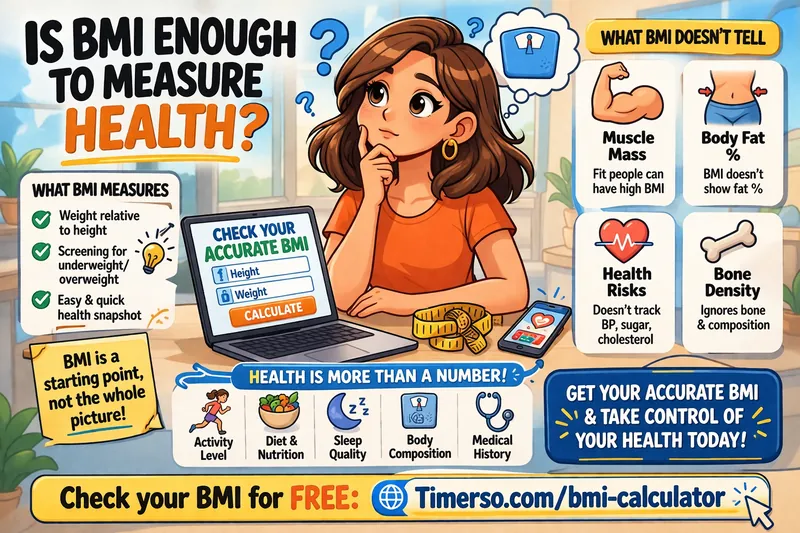
For decades, the Body Mass Index (BMI) has reigned supreme in doctors' offices, fitness assessments, and public health guidelines. It is often the first number calculated at an annual physical, and for many, it acts as the ultimate judge of whether they are "healthy" or "unhealthy."
But as metabolic science advances, a growing chorus of medical professionals, nutritionists, and researchers are pushing back against this singular metric. The pressing question in modern healthcare is: Is BMI enough to measure health?
The unequivocal medical consensus is no. While BMI is a useful starting point, relying on it as the sole indicator of your well-being can be misleading, and in some cases, entirely inaccurate. Here is a deep dive into what BMI actually measures, its critical blind spots, and the holistic metrics you should be tracking instead.
What is BMI and Why is it Still Used?
Before we dismantle it, we must understand what BMI is. Developed in the 1830s, the Body Mass Index is a mathematical formula that divides your weight in kilograms by your height in meters squared.
It is used globally because it is: * Non-invasive: It requires no blood work or expensive imaging. * Fast and Free: Anyone can calculate it instantly. * Statistically Relevant for Populations: On a macro scale, high BMI correlates strongly with population-wide increases in heart disease and type 2 diabetes.
If you are beginning a wellness journey and want to establish a baseline, calculating your score is a valid first step. You can easily use a tool to check your current BMI to see where you land on the standard World Health Organization (WHO) scale. However, once you have that number, you must look further.
The 4 Major Blind Spots of BMI
BMI was designed to study populations, not to diagnose individuals. When applied to a single person, the formula falls short in several critical ways:
1. It Cannot Distinguish Between Muscle and Fat
This is the most famous flaw of the BMI system. By volume, muscle tissue is significantly denser and heavier than fat tissue. A highly trained athlete, a weightlifter, or a naturally broad-shouldered individual will often register as "Overweight" or even "Obese" on a BMI chart, despite having a very low body fat percentage and elite cardiovascular health.
2. It Ignores Fat Distribution
From a health perspective, where you store fat is much more important than how much you weigh. * Subcutaneous Fat: The fat stored just beneath the skin (often around the hips and thighs) is relatively harmless. * Visceral Fat: The fat stored deep within the abdominal cavity, wrapping around your organs, is highly inflammatory and is a primary driver of metabolic syndrome. Two people can have the exact same BMI, but if one carries their weight as visceral fat and the other as subcutaneous fat, their health risks are completely different.
3. It Fails to Account for Age and Gender
Women naturally carry a higher percentage of essential body fat than men for reproductive health, yet the standard adult BMI chart does not differentiate between biological sexes. Furthermore, as we age, we naturally lose muscle mass and bone density. An older adult might maintain a "Healthy" BMI while simultaneously experiencing dangerous levels of muscle loss (sarcopenia).
4. It Lacks Ethnic Context
Extensive medical research reveals that different ethnic groups experience metabolic risks at different body weights. For example, populations of South Asian descent often develop markers for type 2 diabetes and cardiovascular disease at significantly lower BMIs than populations of European descent. A universal, one-size-fits-all chart fails to capture these vital genetic nuances.
The Holistic Approach: Metrics to Track Instead
If a tool to check your current BMI tells you that you are "overweight," do not panic. Instead, partner with your healthcare provider to look at a broader, more accurate picture of your metabolic health.
Focus on these key indicators:
- Waist Circumference: A tape measure is often more valuable than a scale. A waist circumference of over 35 inches for non-pregnant women, or over 40 inches for men, is a strong indicator of dangerous visceral fat.
- Comprehensive Blood Panel: Your metabolic health happens on a cellular level. Routinely check your fasting glucose, HbA1c, triglycerides, and cholesterol levels.
- Blood Pressure: A silent indicator of cardiovascular stress that has nothing to do with how you look in the mirror.
- Physical Endurance and Strength: How easily can you climb a flight of stairs? What is your resting heart rate? Functional fitness is a far better predictor of longevity than a mathematical ratio.
Conclusion
Is BMI enough to measure your health? Absolutely not. It is merely a single data point in a vast and complex biological system. While it remains a helpful, quick-reference screening tool, true health is defined by your metabolic function, your physical strength, your mental well-being, and your daily lifestyle habits. Look beyond the scale, and treat your body with the nuanced care it deserves.
Authoritative References for Further Reading (E.E.A.T)
To ensure your health decisions are guided by the highest standards of medical science, consult these trusted, peer-reviewed resources:
- Centers for Disease Control and Prevention (CDC): Provides detailed clinical considerations regarding BMI, explicitly acknowledging its limitations in assessing body fat and muscle mass. (cdc.gov)
- Harvard T.H. Chan School of Public Health: Offers extensive research on the dangers of visceral fat, the importance of waist circumference, and why BMI is an imperfect measure. (hsph.harvard.edu)
- World Health Organization (WHO): Outlines global data and recent initiatives pushing for more nuanced, multi-metric approaches to diagnosing obesity and metabolic health. (who.int)
- American Medical Association (AMA): In recent years, the AMA has officially recognized the historical harm and clinical limitations of using BMI alone as a diagnostic tool in clinical practice. (ama-assn.org)
(Disclaimer: This article is intended for educational and informational purposes only and does not constitute medical advice. Because individual health profiles vary greatly based on genetics, body composition, and medical history, always consult with a licensed physician or registered dietitian for a personalized health assessment.)