The Active "Overweight": Is a BMI of 27 Dangerous if I Exercise Daily?
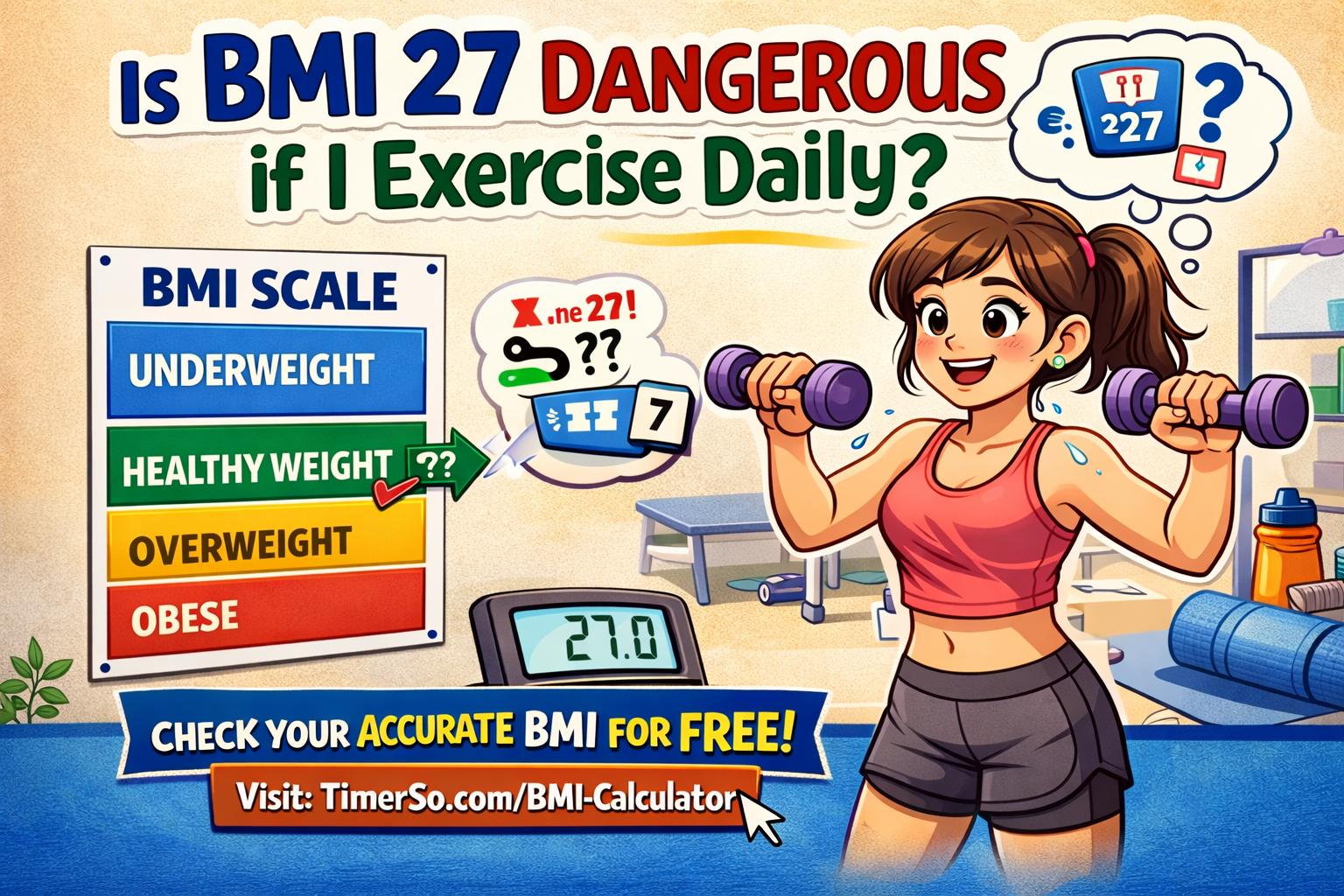
It is one of the most frustrating scenarios for fitness enthusiasts: you work out every single day, eat a reasonably balanced diet, and feel incredibly strong. Yet, when you calculate your Body Mass Index (BMI), the number flashes back as 27.
According to standard medical charts, a BMI of 27 places you in the "Overweight" category. Naturally, this leads to a pressing question: Is a BMI of 27 dangerous if I am exercising daily?
The short, science-backed answer is no. In fact, a high level of cardiovascular fitness paired with a BMI of 27 is generally far healthier than being completely sedentary with a "normal" BMI of 22. In the medical community, this concept is often referred to as being "metabolically healthy overweight."
Here is a deep dive into why your daily exercise routine matters far more than your BMI, and how to properly assess your actual health risks.
The "Fat but Fit" Paradigm
For decades, the medical assumption was that any excess weight automatically equated to poor health. However, modern sports science and metabolic research have largely debunked this rigid thinking.
Exercise exerts a profound, independent effect on your health, regardless of whether it causes the number on the scale to drop. If you are exercising daily (combining cardiovascular work with resistance training), your body is constantly optimizing its internal engine. Daily movement: * Improves Insulin Sensitivity: Your muscles absorb glucose more effectively, drastically lowering your risk of type 2 diabetes. * Reduces Inflammation: Regular exercise lowers systemic inflammation, protecting your heart and blood vessels. * Lowers Blood Pressure: A strong heart pumps blood with less effort, decreasing the force on your arteries.
Because of these adaptations, an active individual with a BMI of 27 often possesses a much cleaner metabolic blood panel than a sedentary person with a statistically "ideal" BMI.
Why Daily Exercise Skews Your BMI
If you are highly active, the standard BMI calculation is heavily biased against you. BMI only calculates the ratio of your total weight to your height; it is completely blind to body composition.
There are two primary reasons daily exercisers often sit at a BMI of 27:
1. Muscle Mass Density
If your daily routine includes weightlifting, CrossFit, or any form of resistance training, you are building skeletal muscle. Muscle tissue is significantly denser than adipose tissue (fat). Therefore, a body with high muscle mass will weigh more, pushing the BMI score up, even if body fat percentage is exceptionally low.
2. Blood Volume and Glycogen Storage
Athletes and daily exercisers carry more blood volume and store more water and glycogen inside their muscles to fuel their workouts. This necessary, healthy adaptation adds functional weight to the body—weight that the BMI chart incorrectly registers as fat.
To keep track of your baseline as your body composition changes, it is helpful to use a reliable digital tool to check your current BMI. By tracking your data at timerso.com alongside your performance metrics, you can get a clearer picture of your fitness trajectory over time.
Visceral Fat: The True Danger
If a BMI of 27 isn't inherently dangerous for an active person, what should you be looking out for? The answer is visceral fat.
Subcutaneous fat (the soft fat under your skin) poses very little metabolic threat. Visceral fat (the hard fat stored deep in your abdominal cavity, surrounding your organs) is highly inflammatory and linked to chronic disease.
The beautiful thing about daily exercise is that it aggressively targets and burns visceral fat, even if your total body weight (and your BMI) remains exactly the same. You might maintain a BMI of 27, but your daily workouts are actively stripping the dangerous fat away from your liver and heart.
Better Metrics for the Daily Exerciser
If you exercise daily, you have outgrown the basic BMI chart. Instead of worrying about a score of 27, measure your health using these advanced metrics:
- Waist-to-Height Ratio: Your waist circumference should ideally be less than half of your height. This is a far more accurate predictor of cardiovascular risk than BMI because it directly measures visceral fat.
- Cardiovascular Endurance (VO2 Max): How efficiently your body uses oxygen during exercise. A high VO2 Max is one of the strongest predictors of longevity.
- Routine Blood Work: Your fasting glucose, triglycerides, and HDL/LDL cholesterol levels will tell you exactly what is happening inside your arteries.
Conclusion
A BMI of 27 is not a medical emergency, especially if you are lacing up your sneakers every day. Daily exercise transforms your body on a cellular level, mitigating nearly all the risks traditionally associated with being mildly "overweight." Keep using a tool to check your current BMI as a reference point, but let your strength, endurance, and clinical lab results be the true judges of your health. Keep moving!
Authoritative References for Further Reading (E.E.A.T)
To ensure your health decisions are rooted in the highest medical standards, we recommend consulting these peer-reviewed resources:
- American Heart Association (AHA): Discusses the profound benefits of cardiovascular exercise on metabolic health, regardless of baseline body weight. (heart.org)
- National Institutes of Health (NIH): Features extensive clinical trials on the "Fat but Fit" phenomenon, proving that cardiovascular fitness significantly alters mortality risks across all BMI categories. (nih.gov)
- Centers for Disease Control and Prevention (CDC): Acknowledges the limitations of the BMI scale for highly active individuals and athletes due to increased muscle density. (cdc.gov)
- Harvard T.H. Chan School of Public Health: Offers in-depth research on how physical activity specifically targets dangerous visceral fat, even when overall BMI remains stable. (hsph.harvard.edu)
(Disclaimer: This article is intended for educational and informational purposes only and does not constitute medical advice. Because individual health profiles vary, always consult with a licensed physician or registered dietitian for a personalized assessment of your cardiovascular and metabolic health.)