The Truth About Your Metrics: What is the Ideal BMI for Women by Age?
The Truth About Your Metrics: What is the Ideal BMI for Women by Age?
If you have ever searched for the "ideal BMI for women by age," you are not alone. Women’s bodies undergo profound, natural transformations throughout their lives—from the hormonal surges of puberty and pregnancy to the metabolic shifts of perimenopause and beyond. It is entirely logical to assume that a healthy weight for a 25-year-old would look different than a healthy weight for a 65-year-old.
However, the medical reality is a bit more nuanced. The standard Body Mass Index (BMI) calculation does not actually change based on your age or gender once you reach adulthood.
But does that mean a single number tells the whole story? Absolutely not. While the formula stays the same, how doctors interpret that number—and what is considered truly "ideal" for your longevity and health—shifts significantly as you age.
Here is a science-backed look at the standard BMI scale, how age impacts what is optimal for women, and why you should look beyond the scale.
The Standard Adult BMI Scale
Body Mass Index is a mathematical ratio of your weight to your height. For all adults (aged 20 and older), both male and female, the World Health Organization (WHO) categorizes BMI as follows:
- Underweight: Below 18.5
- Healthy Weight: 18.5 – 24.9
- Overweight: 25.0 – 29.9
- Obesity: 30.0 and above
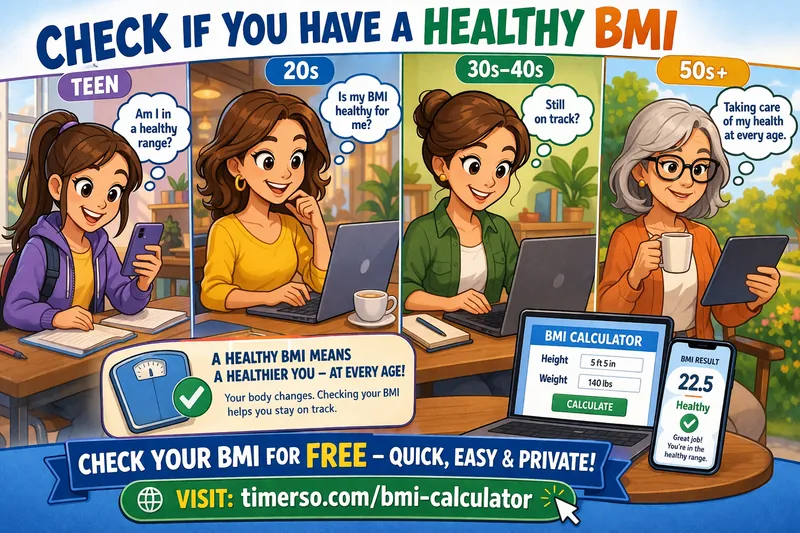
To find your current baseline, it is highly recommended to use a tool to check if your BMI is healthy. By inputting your height and weight into a free calculator like timerso.com, you can instantly see where you land on this universal scale.
How the "Ideal" BMI Shifts Through the Decades
While the CDC and WHO charts remain static, gerontologists and women’s health experts look at the data differently depending on your stage of life.
In Your 20s and 30s: The Standard Applies
During your peak reproductive years, aiming for the standard "Healthy Weight" range (18.5 – 24.9) is generally ideal. Maintaining a healthy BMI during these decades is closely tied to optimal fertility, cardiovascular health, and the prevention of early-onset type 2 diabetes. However, women who are highly active or strength train may find their BMI tipping into the "Overweight" category due to dense muscle mass, which is perfectly healthy.
In Your 40s and 50s: The Menopause Transition
As women enter perimenopause and menopause, estrogen levels drop. This hormonal shift naturally slows the metabolism, decreases muscle mass (sarcopenia), and changes fat distribution—moving it from the hips and thighs to the abdomen (visceral fat).
During this time, the number on the BMI chart might stay exactly the same, but your body composition is changing. The "ideal" focus here shouldn't just be maintaining a BMI under 25, but actively preserving muscle mass through protein intake and strength training to counteract age-related metabolic slowdown.
In Your 60s and Beyond: The "Obesity Paradox"
This is where the medical consensus diverges from the standard chart. For women over 65, aiming for the lower end of the "Healthy Weight" category is often discouraged.
Extensive research, including data highlighted by the National Institutes of Health (NIH), points to what is known as the "obesity paradox" in older adults. For senior women, a slightly higher BMI—typically in the 25.0 to 27.0 range (the lower end of the "Overweight" category)—is actually associated with lower mortality rates.
A bit of extra weight in your later years provides a crucial nutritional reserve during illness and increases bone density, offering protection against osteoporosis, frailty, and fatal falls. For a 75-year-old woman, being slightly "overweight" is often more ideal than being on the thinner side.
Why BMI is Just the Beginning
If you have used a tool to check if your BMI is healthy and are frustrated by the result, remember that BMI is a screening tool, not a diagnostic test. It has several blind spots, particularly for women:
- It ignores muscle density: Muscle weighs more than fat by volume.
- It ignores fat distribution: Where you carry your weight matters more than the total weight. Visceral (belly) fat is linked to higher metabolic risks than subcutaneous fat.
- It ignores genetics and ethnicity: Different ethnic groups carry different metabolic risks at identical BMIs.
For a complete picture, modern healthcare guidelines suggest pairing your BMI with a waist circumference measurement. For non-pregnant women, a waist measuring 35 inches or more indicates a higher risk for health problems, regardless of your overall BMI.
Conclusion
The ideal BMI for a woman is not a static number etched in stone; it is a moving target that evolves with your biology. While the standard 18.5 – 24.9 range is a great benchmark for younger adults, a slightly higher BMI often offers protective benefits in your senior years.
Focus less on hitting a flawless mathematical ratio and more on sustainable habits: eating nutrient-dense foods, lifting weights to preserve bone and muscle, and getting enough sleep. Let your BMI be a helpful guidepost, but let your energy levels, strength, and overall vitality be the ultimate measure of your health.
Authoritative References for Further Reading (E.E.A.T)
To ensure you are making the best decisions for your lifelong health, consult these peer-reviewed and authoritative medical sources:
- Centers for Disease Control and Prevention (CDC): Provides the clinical definitions of BMI, its limitations, and guidance on assessing health risks beyond the scale. (cdc.gov)
- The North American Menopause Society (NAMS): Offers expert, evidence-based insights into how menopause affects body composition, fat distribution, and metabolic health. (menopause.org)
- National Institutes of Health (NIH) / National Institute on Aging (NIA): Features clinical studies on the "obesity paradox" and weight management guidelines specific to older adults. (nia.nih.gov)
- American College of Obstetricians and Gynecologists (ACOG): Provides comprehensive guidelines on healthy weight maintenance for women through all reproductive and post-reproductive stages. (acog.org)
(Disclaimer: This article is intended for educational and informational purposes only and does not constitute medical advice. Because individual health needs vary greatly by age and medical history, always consult with a licensed physician or a registered dietitian before making significant changes to your diet or lifestyle.)