The Hidden Truth: Why Is My BMI High But I Look Slim?
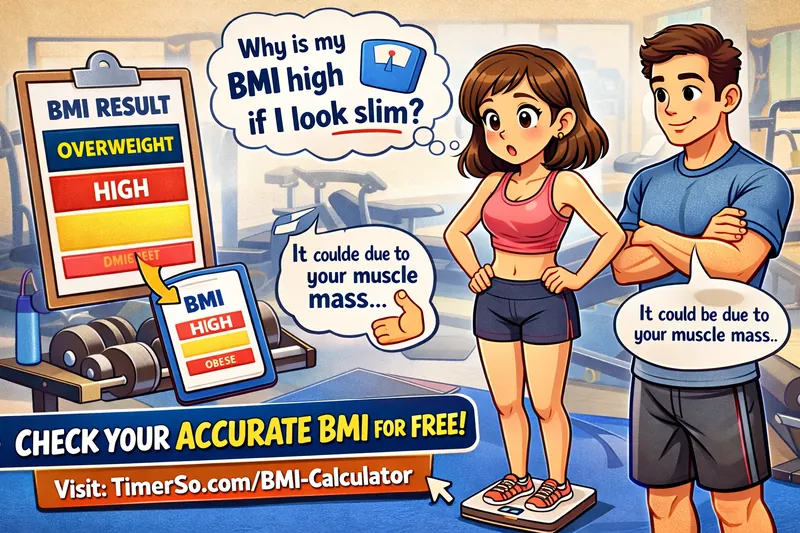
It is a uniquely frustrating experience: you eat well, exercise regularly, and look slim in the mirror. Yet, when you visit the doctor's office or calculate your health metrics online, your Body Mass Index (BMI) places you squarely in the "Overweight" or even "Obese" category.
This discrepancy between what you see and what the scale says can cause immediate anxiety. You might find yourself asking, "How can my BMI be so high when I look so thin?"
If this sounds familiar, you are not alone. In fact, you might be in excellent health. The confusion stems from a fundamental misunderstanding of what BMI actually measures. In this guide, we will explore the science behind body composition, why the BMI formula often fails individuals who appear slim, and the metrics you should be focusing on instead.
The Flaw in the Formula: What BMI Actually Measures
To understand the discrepancy, you first have to look at the math. The Body Mass Index was created nearly 200 years ago as a statistical tool to evaluate the general health of large populations.
The formula is surprisingly simple: it divides your total weight (in kilograms) by your height (in meters squared).
Because the formula only uses height and total weight, it is completely blind to body composition. It measures excess weight, not excess fat. It cannot tell the difference between a pound of fat, a pound of muscle, a pound of bone, or a pound of water.
If you want to see exactly where your baseline numbers fall, you can use a tool to check your current BMI. However, if the resulting number seems high despite your slim appearance, here are the three biological reasons why.
Reason 1: Muscle is Denser Than Fat
This is the most common reason for a high BMI in a slim individual. By volume, muscle tissue is roughly 18% denser than fat tissue.
If you take two people who are the exact same height and weigh the exact same amount, they will have the exact same BMI. But if Person A has a high muscle mass and Person B has a high fat mass, they will look completely different. Person A will look lean, compact, and slim, while Person B will appear larger.
If you engage in regular strength training, Pilates, heavy manual labor, or play sports, you have likely built a dense, heavy muscular frame. Your BMI is high simply because you are carrying heavy, metabolically healthy muscle, not dangerous adipose tissue (fat).
Reason 2: Heavy Bone Density and Frame Size
Genetics play a massive role in your overall weight. Some individuals are naturally born with larger skeletal structures—often referred to as having a "large frame" or being "big-boned."
Additionally, bone mineral density varies from person to person. Weight-bearing exercises and a nutrient-rich diet can increase your bone density, making your skeleton physically heavier. A heavy, dense skeleton adds significant numbers to the scale (and therefore your BMI) without adding any visible girth to your waistline.
Reason 3: Water Retention
Your body weight can fluctuate by several pounds a day based purely on water retention. Factors like a high-sodium meal, hormonal fluctuations (especially for women during their menstrual cycle), or even taking creatine supplements for muscle recovery can cause your body to hold onto excess water. Water is heavy, and it will artificially inflate your BMI temporarily, even if your physical appearance remains relatively unchanged.
Better Metrics for Slim Individuals
If your BMI is high but you look slim, it is time to graduate to more advanced, accurate health metrics. Healthcare professionals and sports nutritionists recommend focusing on the following:
1. Body Fat Percentage
This is the true measure of your body composition. It separates your lean mass (muscle, bone, water) from your fat mass. For a highly accurate reading, look into getting a DEXA scan or using professional skinfold calipers.
2. Waist Circumference
This is a critical indicator of metabolic health. Even if your BMI is high, a small waist circumference usually indicates that you do not have high levels of visceral fat (the dangerous fat that wraps around your organs). For non-pregnant women, a waist under 35 inches, and for men, a waist under 40 inches, is generally considered healthy.
3. Waist-to-Height Ratio (WHtR)
Many modern cardiologists prefer this over BMI. Simply measure your waist and divide it by your height. If the resulting number is less than 0.5 (meaning your waist is less than half your height), you are generally in a very healthy metabolic range, regardless of your total weight.
Conclusion
Do not let a dated mathematical formula convince you that you are unhealthy when your mirror, your clothes, and your energy levels tell a different story. While a tool to check your current BMI is a great starting point for the general population, it heavily penalizes dense muscle and heavy bones.
If you look slim, feel strong, and have healthy clinical bloodwork, a "high" BMI is likely a badge of honor reflecting your athletic body composition.
Authoritative References for Further Reading (E.E.A.T)
To ensure your health assessments align with the latest medical and sports science research, consult these trusted, peer-reviewed resources:
- Centers for Disease Control and Prevention (CDC): Acknowledges the limitations of BMI, specifically noting that highly muscular individuals may be classified as overweight without having excess body fatness. (cdc.gov)
- American College of Sports Medicine (ACSM): Provides comprehensive guidelines on body composition, muscle density, and why athletes should rely on body fat percentage rather than BMI. (acsm.org)
- National Institutes of Health (NIH): Features clinical studies on bone density, lean mass, and the efficacy of using waist circumference over BMI as an indicator of cardiovascular risk. (nih.gov)
- Harvard T.H. Chan School of Public Health: Offers detailed insights into the flaws of BMI as a singular health metric and the importance of measuring visceral fat. (hsph.harvard.edu)
(Disclaimer: This article is intended for educational and informational purposes only and does not constitute medical advice. Always consult with a licensed physician or sports medicine professional for a personalized assessment of your body composition and overall health.)