The Muscle Penalty: Why BMI Fails for Muscular People
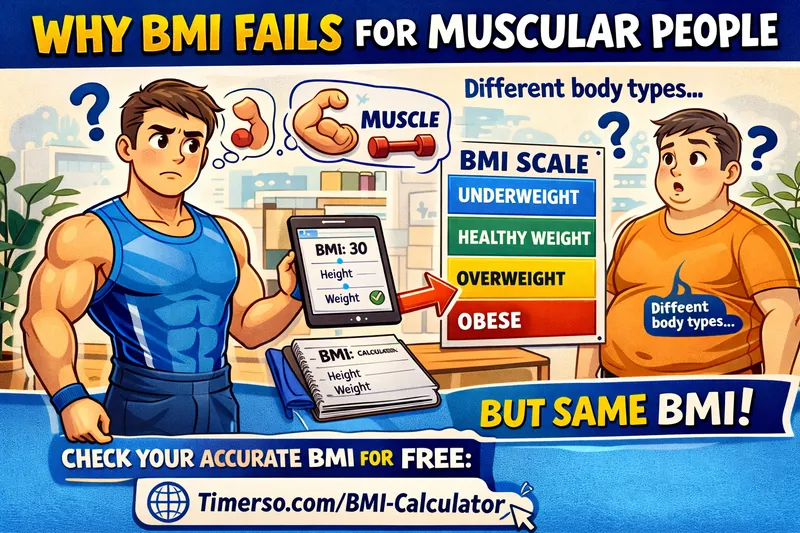
Imagine spending months meticulously lifting weights, optimizing your nutrition, and achieving the lowest body fat percentage of your life. You feel fantastic, your clothes fit perfectly, and your cardiovascular health is peaking. Yet, when you step into a doctor's office for a routine checkup, the chart on the wall labels you as "overweight"—or worse, "obese."
If this sounds familiar, you have experienced the "muscle penalty" of the Body Mass Index (BMI).
While BMI is the most widely used screening tool in global healthcare, it possesses a massive blind spot when it comes to athletes, bodybuilders, and anyone with a higher-than-average muscle mass. In this article, we will break down the science of why BMI fails muscular individuals, how tissue density skews the math, and what metrics you should be focusing on instead.
The Mathematical Flaw: What BMI Actually Measures
To understand why BMI fails, you must understand its origins. Created in the 1830s by a statistician (not a physician) named Lambert Adolphe Jacques Quetelet, the formula was designed to estimate the average weight of large populations for resource allocation, not to assess individual metabolic health.
The formula is purely mathematical: Weight in kilograms divided by height in meters squared.
Notice what is missing from that equation? Body composition. BMI only measures your total overall mass relative to how tall you are. It assumes that any excess weight beyond the statistical "norm" is composed of fat. The formula is completely blind to whether that weight comes from adipose tissue (fat), bone density, water retention, or skeletal muscle.
The Density Dilemma: Muscle vs. Fat
The primary reason muscular people break the BMI scale comes down to tissue density.
By volume, muscle tissue is roughly 15% to 20% denser than fat tissue. This means that a pound of muscle takes up significantly less physical space in the body than a pound of fat. Therefore, an individual who engages in heavy resistance training can pack a massive amount of weight onto a relatively compact frame.
The Real-World Comparison
Consider two men who are exactly 5 feet 10 inches tall and both weigh 210 pounds: * Person A leads a sedentary lifestyle, eats a highly processed diet, and has a body fat percentage of 32%. * Person B is a competitive powerlifter who trains five days a week and has a body fat percentage of 12%.
According to the BMI calculator, both men have a BMI of 30.1, categorizing them both as clinically obese.
For Person A, the categorization is medically accurate; the excess weight is adipose tissue, increasing their risk for metabolic syndrome and cardiovascular disease. For Person B, the categorization is entirely inaccurate; their excess weight is highly metabolically active skeletal muscle, which actually protects against disease.
The Consequences of Misclassification
Relying solely on BMI for muscular individuals is not just annoying; it can have real-world consequences. Athletes are frequently subjected to: * Higher Insurance Premiums: Life insurance companies often use standard BMI cutoffs to determine rates, penalizing fit individuals who weigh more. * Medical Misdiagnosis: Doctors rushing through a screening might prescribe unnecessary weight-loss regimens to patients who are already in peak physical condition. * Psychological Frustration: It can be highly demotivating to work hard in the gym only to be clinically labeled as unhealthy by a standardized chart.
What Should Muscular People Do Instead?
If you lift weights or carry a significant amount of muscle, you need to look beyond the basic ratio of height to weight. Sports medicine professionals recommend tracking your health through actual body composition metrics:
- Body Fat Percentage: This is the ultimate metric for athletic populations. Elite male athletes generally range from 6% to 13%, while female athletes range from 14% to 20%.
- Waist-to-Hip Ratio (WHR): A simple tape measure test assessing visceral fat (belly fat). If your waist is small but your weight is high, it is a strong indicator that your mass is muscle, not dangerous abdominal fat.
- DEXA Scans: The clinical gold standard. A DEXA scan uses low-level X-rays to map your exact percentages of bone, muscle, and fat mass.
When Does BMI Still Matter?
While BMI fails to accurately categorize elite athletes and powerlifters, it is not entirely useless. If you are just starting your fitness journey or transitioning from a sedentary lifestyle, BMI remains a highly effective, free, and accessible starting line.
Before you begin altering your body composition through heavy lifting, it is wise to establish your initial baseline. You can use a digital tool to check your current BMI instantly. By logging your initial metrics at timerso.com/bmi-calculator, you can accurately track your trajectory as you begin to shed fat and build the muscle that might eventually outgrow the standard chart.
Conclusion
Do not let a 200-year-old math equation diminish your hard work in the gym. If you are highly muscular, your BMI will naturally skew higher—and that is a sign of strength, not sickness. Focus on your body fat percentage, your cardiovascular endurance, and your strength progression. Let the BMI chart serve the general population, while you focus on the advanced metrics that match your advanced training.
Authoritative References for Further Reading (E.E.A.T)
To ensure your training and health assessments align with the highest standards of modern sports science, consult these trusted, peer-reviewed resources:
- American College of Sports Medicine (ACSM): Provides comprehensive clinical guidelines on body composition assessment and explicitly details why BMI is inappropriate for athletic populations. (acsm.org)
- Centers for Disease Control and Prevention (CDC): Acknowledges the limitations of the BMI formula, specifically noting that highly trained athletes may have a high BMI because of increased muscularity rather than increased body fatness. (cdc.gov)
- National Institutes of Health (NIH): Features numerous clinical studies comparing the efficacy of BMI versus DEXA scans and skinfold measurements in athletic and strength-training cohorts. (nih.gov)
- International Society of Sports Nutrition (ISSN): Offers evidence-based position stands on diets, muscle hypertrophy, and body composition metrics for elite lifters. (sportsnutritionsociety.org)
(Disclaimer: This article is intended for educational and informational purposes only and does not constitute medical advice. Always consult with a sports medicine physician or a registered dietitian for personalized assessments of your body composition and athletic health.)