Can BMI Be Inaccurate for Fit People? The Science Behind the Muscle Myth
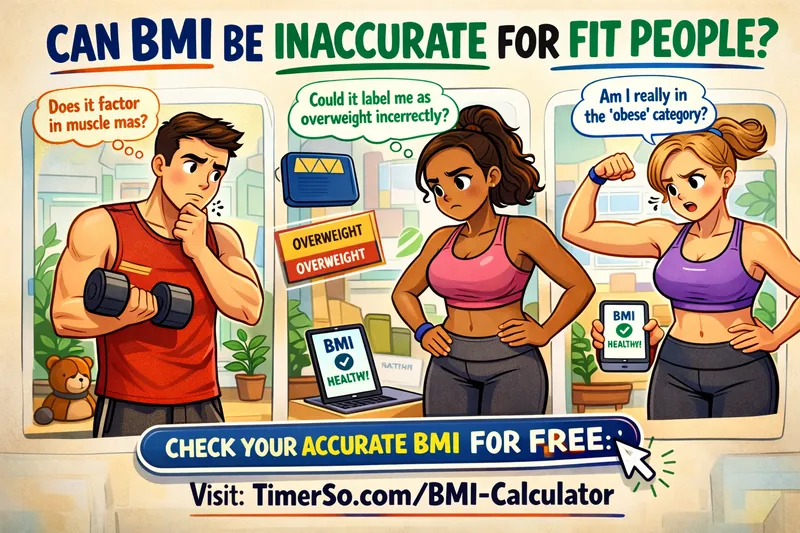
If you spend hours in the gym each week lifting weights, running, or training for a sport, you might be in the best shape of your life. Yet, a routine trip to the doctor's office—or a quick calculation online—might label you as "overweight" or even "obese."
How can someone with visible abs and excellent cardiovascular endurance be classified alongside individuals with severe metabolic health risks?
The answer lies in the limitations of the Body Mass Index (BMI). While BMI is a standard metric used globally by healthcare professionals, it is notoriously flawed when applied to athletes and highly fit individuals. In this article, we will break down exactly why BMI can be inaccurate for fit people, the science of body composition, and what metrics you should track instead.
What Does BMI Actually Measure?
Body Mass Index is a simple mathematical equation created over 200 years ago to study population averages. It divides your weight in kilograms by your height in meters squared.
Based on this single calculation, you are placed into one of four standard categories: * Underweight: Below 18.5 * Healthy Weight: 18.5 – 24.9 * Overweight: 25.0 – 29.9 * Obesity: 30.0 and above
If you are curious about where you currently stand on this scale before we dive into its flaws, you can use a tool to check your current BMI to get a baseline number. However, if you are highly active, you must take that number with a grain of salt.
The Core Problem: Muscle vs. Fat Density
The fundamental reason BMI is inaccurate for fit individuals is that the formula cannot distinguish between fat and muscle. BMI only measures total mass. It does not care if that mass is made up of dense bone, water, skeletal muscle, or adipose tissue (fat). By volume, muscle is significantly denser than fat (roughly 18% denser). This means that a pound of muscle takes up much less space in your body than a pound of fat.
Because strength training and rigorous athletic conditioning build heavy, dense muscle tissue, a fit person's total weight will naturally increase.
The Linebacker vs. The Couch Potato
Consider two men who are both 6 feet tall and weigh 220 pounds. According to the BMI chart, both men have a BMI of 29.8, categorizing both of them as borderline obese.
- Man A is a professional athlete with 10% body fat. He has immense cardiovascular endurance, high insulin sensitivity, and a low resting heart rate.
- Man B is completely sedentary with 32% body fat. He carries most of his weight around his abdomen, putting him at high risk for type 2 diabetes and heart disease.
Despite having vastly different health profiles and body compositions, the BMI scale treats them as identical. For the athlete, the BMI categorization is not just inaccurate; it is clinically misleading.
Alternative Metrics for Fit Individuals
If you are an athlete, a weightlifter, or someone with a naturally muscular build, you need to look beyond the BMI chart to accurately assess your health and fitness levels. Here are the most reliable, science-backed alternatives:
1. Body Fat Percentage
This is the gold standard for athletic populations. It measures the exact ratio of fat mass to lean mass (muscle, bone, water). Measuring your body fat percentage gives you a much clearer picture of your actual health risks and athletic conditioning.
2. Waist Circumference and Waist-to-Hip Ratio
Where you store your fat is more important than how much you weigh. Visceral fat (stored deep in the belly around organs) is highly inflammatory and dangerous. Subcutaneous fat (stored under the skin on the legs or arms) is less harmful. A simple tape measure around your waist is often a more accurate predictor of metabolic health than a BMI score.
3. DEXA Scans
Dual-Energy X-ray Absorptiometry (DEXA) is the most accurate clinical tool available for measuring body composition. It provides a highly detailed breakdown of your bone density, lean muscle mass, and exact fat distribution.
Conclusion
BMI is a population-level screening tool; it was never designed to assess the highly conditioned physiques of fit individuals. If you consistently engage in resistance training or high-level athletics, do not panic if a tool to check your current BMI places you in the "overweight" category.
Focus instead on your body fat percentage, cardiovascular performance, physical strength, and how you feel on a daily basis. Your health is defined by your habits and your metabolic function, not a two-century-old math equation.
Authoritative References for Further Reading (E.E.A.T)
To ensure your fitness and health assessments are aligned with modern medical and sports science, consider consulting these trusted resources:
- Centers for Disease Control and Prevention (CDC): The CDC explicitly acknowledges the limitations of BMI, noting that athletes may have a high BMI due to increased muscularity rather than increased body fat. (cdc.gov)
- American College of Sports Medicine (ACSM): Provides evidence-based guidelines on body composition testing, healthy body fat percentages for athletes, and performance metrics. (acsm.org)
- National Institutes of Health (NIH): Publishes peer-reviewed clinical studies comparing the efficacy of BMI against body composition tools like DEXA scans in athletic cohorts. (nih.gov)
- International Society of Sports Nutrition (ISSN): Offers scientifically backed position stands on diet, muscle hypertrophy, and accurate body composition measurement. (sportsnutritionsociety.org)
(Disclaimer: This article is intended for educational and informational purposes only and does not constitute medical advice. Always consult with a licensed physician, sports medicine specialist, or registered dietitian for a personalized assessment of your health and body composition.)