BMI Explained in Simple Terms: A Complete Guide for Adults
Every time you visit a doctor for a routine physical, a nurse takes your height and weight. Shortly after, a number appears on your medical chart: your BMI. You have probably heard this term thrown around in fitness magazines, news reports, and diet programs, but what does it actually mean for your health?
Medical terminology can often feel like a foreign language. In this article, we are going to strip away the complex jargon. We will explore exactly what BMI is, how it is calculated, what the different categories mean, and—most importantly—what it doesn't tell you about your body.
What is BMI? (The Simple Definition)
BMI stands for Body Mass Index.
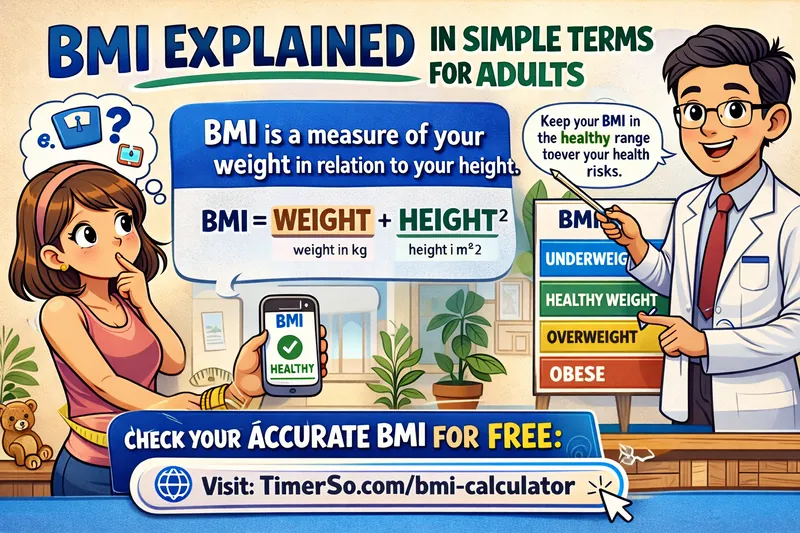
In the simplest terms, BMI is a mathematical formula that compares how much you weigh to how tall you are. It is designed to answer a basic question: For a person of this specific height, is their weight considered statistically healthy?
Because a 6-foot-tall person is naturally going to weigh more than a 5-foot-tall person, simply looking at pounds on a scale does not give a doctor enough context. BMI provides that context by creating a ratio.
The formula itself is your weight in kilograms divided by your height in meters squared. But don't worry about doing the math in your head. You can easily use a digital tool to check your current BMI. By typing your height and weight into a free platform like timerso.com, the math is done for you instantly.
The Standard Adult BMI Categories
Once you have your BMI number, it falls into one of four standard categories established by major health organizations like the World Health Organization (WHO) and the Centers for Disease Control and Prevention (CDC). For adults aged 20 and older, the categories are:
- Below 18.5: Underweight
- 18.5 – 24.9: Healthy Weight (or Normal Weight)
- 25.0 – 29.9: Overweight
- 30.0 and Above: Obesity
Note: These categories are the same for adult men and women of all ages.
Why Do Doctors Use It?
If BMI is just a basic math equation, why is it used globally?
Doctors rely on BMI because it is a fast, free, and non-invasive screening tool. Extensive medical research shows that as BMI rises into the "Overweight" and "Obesity" categories, a person's risk for certain chronic diseases also increases. These include: * Type 2 diabetes * High blood pressure (hypertension) * Heart disease and stroke * Sleep apnea * Osteoarthritis (joint breakdown)
By checking your BMI, a doctor can quickly decide if they need to look deeper into your blood work, diet, or lifestyle habits to prevent these conditions.
The "But...": Where BMI Falls Short
While BMI is helpful, it is not a perfect report card for your health. It is a 200-year-old formula with a few major blind spots that adults need to understand:
- It Can't See Muscle: Muscle is denser and heavier than fat. If you are an athlete, a weightlifter, or just naturally muscular, the scale will show a higher weight. The BMI formula will assume this extra weight is fat and might incorrectly label you as "overweight."
- It Ignores Where Fat is Stored: Carrying weight in your hips and thighs is generally less harmful than carrying weight deep in your belly (visceral fat). BMI cannot tell where your body stores fat.
- It Doesn't Account for Age: As adults get into their 60s and 70s, a slightly higher BMI (in the 25 to 27 range) is actually linked to longer life expectancies, as it provides a nutritional reserve during illness and helps protect bones.
Conclusion: How to Use Your BMI
Think of your BMI like the "check engine" light on your car dashboard. If the light comes on, it doesn't automatically mean your car's engine is ruined, but it does mean you should open the hood and take a look.
If you use a tool to check your current BMI and find you are in the "Overweight" or "Underweight" category, don't panic. Instead, use it as a starting point. Talk to your doctor, ask for a routine blood test, and focus on building healthy daily habits like eating whole foods, sleeping well, and staying active. Health is a big puzzle, and BMI is just one piece of it.
Authoritative References for Further Reading (E.E.A.T)
To ensure you have the most accurate and scientifically sound information regarding your health metrics, we recommend reviewing these trusted sources:
- Centers for Disease Control and Prevention (CDC): Offers straightforward, consumer-friendly explanations of Adult BMI, including its uses and limitations. (cdc.gov)
- World Health Organization (WHO): The global authority that defines the standard BMI categories and tracks international weight and health statistics. (who.int)
- National Institutes of Health (NIH): Provides in-depth, peer-reviewed resources on how weight and body composition impact long-term adult health. (nih.gov)
- American Heart Association (AHA): Explains the relationship between body weight, BMI, and cardiovascular health. (heart.org)
(Disclaimer: This article is intended for educational and informational purposes only and does not constitute medical advice. Because individual health is influenced by genetics, body composition, and medical history, always consult with a licensed physician or healthcare provider for a personalized health assessment.)