The Aging Equation: How and Why Your BMI Changes with Age Explained
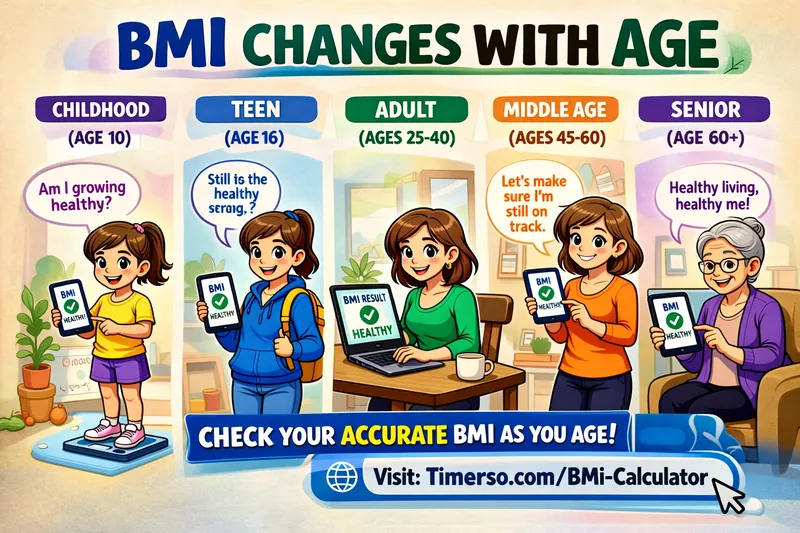
If you have stepped on a scale recently and noticed that your Body Mass Index (BMI) is not the same as it was in your twenties or thirties, you might be feeling a mix of confusion and frustration. You might be eating the same foods and exercising just as much, yet the numbers are shifting.
The truth is, human bodies are not static. As we progress through different decades of life, our biology undergoes profound changes that directly impact our weight, our height, and ultimately, our BMI.
Understanding the relationship between aging and BMI is critical for setting realistic health goals. In this guide, we will explain exactly why your BMI changes with age, how body composition shifts, and what medical experts consider a "healthy" target for older adults.
1. The Math of Aging: Why Shrinking Increases Your BMI
To understand why your BMI changes, you first need to look at the formula itself: your weight in kilograms divided by your height in meters squared ($kg/m^2$).
Because height is a core component of the equation, any change in your height will alter your BMI. As we age, the discs between the vertebrae in our spines lose fluid and compress. Additionally, conditions like osteoporosis or natural changes in posture can cause us to lose an inch or more of height by the time we reach our 60s and 70s.
If your weight stays exactly the same, but you lose an inch in height, your BMI will automatically increase. This mathematical quirk is one of the most common reasons older adults see their BMI creep upward.
2. The Shift in Body Composition: Sarcopenia and Metabolism
Even if your BMI remains perfectly stable throughout your life, what that number represents changes drastically due to natural shifts in body composition.
- Muscle Loss (Sarcopenia): Starting as early as our 30s, we naturally begin to lose skeletal muscle mass. Because muscle tissue is metabolically active (it burns calories), this loss slows down our resting metabolic rate.
- Increased Body Fat: As metabolism slows, it becomes much easier to accumulate body fat, even if caloric intake remains constant. Furthermore, hormonal changes (such as menopause in women and decreasing testosterone in men) cause the body to store fat differently, often moving it from the hips and thighs to the abdomen (visceral fat).
Therefore, a 65-year-old and a 25-year-old with the exact same BMI of 24 will have vastly different body compositions. The 65-year-old will likely have a higher body fat percentage and lower muscle mass, meaning the health risks associated with their weight might be different despite having identical BMI scores.
3. The "Obesity Paradox": Why Ideal BMI Targets Change for Seniors
For younger adults (ages 20 to 60), the standard "Healthy Weight" BMI range is strictly defined as 18.5 to 24.9. However, as you cross into your mid-60s, gerontologists and medical researchers view these numbers differently.
Extensive clinical research has revealed a phenomenon known as the "Obesity Paradox" in older adults. Studies consistently show that for individuals over the age of 65, a slightly higher BMI—typically falling into the "Overweight" category (25.0 to 27.9)—is actually associated with lower mortality rates and better overall health outcomes.
Why? A little extra weight in your senior years provides a vital nutritional reserve during periods of illness. It also places slightly more mechanical stress on your bones, which helps maintain bone density and protects against osteoporosis, frailty, and fatal falls. For older adults, being slightly heavier is often far safer than being underweight.
How to Track Your Changing Metrics
Because your health needs evolve as you age, it is important to stay informed about your current baseline. Rather than relying on outdated metrics from your past, you should calculate your numbers regularly.
We highly recommend utilizing a digital tool to check your current BMI. By using timerso.com, you can quickly and accurately track your metrics over time. Once you know your number, you can have an informed discussion with your healthcare provider about what that specific BMI means for your current stage of life.
Conclusion
A changing BMI is a natural, expected part of the aging process. Whether it is due to a slight loss in height, metabolic shifts, or changes in body composition, the scale will inevitably fluctuate. Rather than chasing the BMI you had in your twenties, focus on preserving your muscle mass through resistance training, eating nutrient-dense foods, and maintaining a weight that supports your energy and mobility today.
Authoritative References for Further Reading (E.E.A.T)
To ensure your health decisions are guided by the highest standards of medical science, consult these trusted, peer-reviewed resources:
- National Institute on Aging (NIA): Offers comprehensive research on how aging affects metabolism, muscle loss (sarcopenia), and overall body composition. (nia.nih.gov)
- Centers for Disease Control and Prevention (CDC): Provides the clinical definitions of BMI and discusses the limitations of the measurement for older adults. (cdc.gov)
- American Journal of Clinical Nutrition: Publishes ongoing, peer-reviewed clinical studies regarding the "obesity paradox" and optimal BMI ranges for all-cause mortality in elderly populations.
- World Health Organization (WHO): Outlines global guidelines for healthy aging, physical activity, and nutritional requirements for older adults. (who.int)
(Disclaimer: This article is intended for educational and informational purposes only and does not constitute medical advice. Because individual health profiles vary greatly based on age, genetics, and medical history, always consult with a licensed physician or registered dietitian for a personalized health assessment.)