Navigating Your Body's Changes: Understanding Safe BMI and Weight Gain Ranges During Pregnancy
Pregnancy is a time of incredible transformation. As your body adapts to grow a new life, the number on the scale will inevitably go up—and it absolutely should! However, amidst the excitement of pregnancy, many expectant mothers feel anxious about how much weight they are gaining and what is considered "safe."
In obstetric care, your Body Mass Index (BMI) plays a crucial role. But here is the most important thing to understand right away: doctors do not use your current pregnant weight to calculate your BMI. Instead, they look at your pre-pregnancy BMI to determine the healthiest weight gain trajectory for the next nine months.
In this guide, we will break down the science of BMI during pregnancy, the officially recommended weight gain ranges, and how to safely nourish yourself and your growing baby.
Why Your Pre-Pregnancy BMI Matters
Your pre-pregnancy BMI gives your healthcare provider a baseline to understand your metabolic starting point. A woman’s body requires extra calories and fat reserves to support the placenta, amniotic fluid, increased blood volume, and the baby's development.
How much extra weight is needed depends entirely on how much reserve you had before conceiving.
To determine your starting point, think back to your weight just before you became pregnant. You can use a tool to check your current BMI (or, in this case, your pre-pregnancy BMI) at timerso.com to establish your baseline category. Once you know your pre-pregnancy BMI, you can understand the recommendations for your safe weight gain range.
Official Weight Gain Guidelines by BMI Category
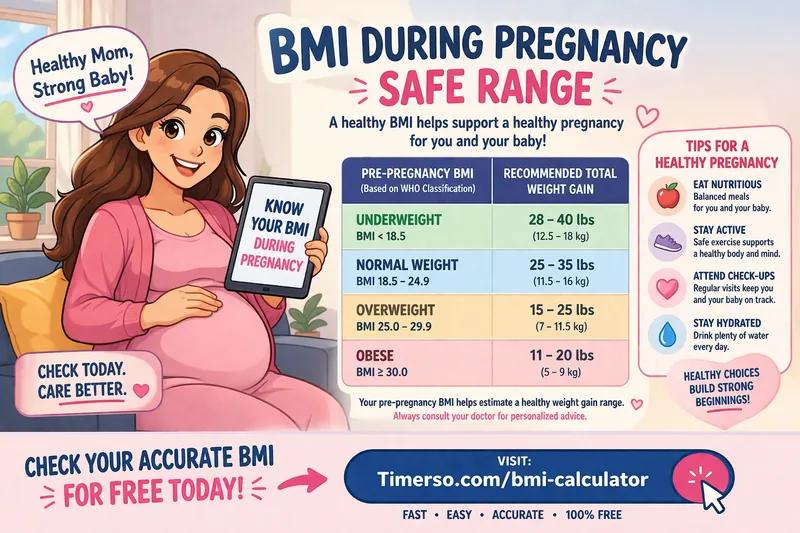
The Institute of Medicine (IOM) and the American College of Obstetricians and Gynecologists (ACOG) have established the following safe weight gain guidelines for singleton pregnancies (one baby).
1. Underweight (Pre-pregnancy BMI below 18.5)
- Recommended Weight Gain: 28 to 40 lbs (12.5 to 18 kg)
- Why: Women starting with a lower body weight need to gain more to ensure the baby receives adequate nutrients for development and to reduce the risk of preterm birth or low birth weight.
2. Healthy Weight (Pre-pregnancy BMI 18.5 – 24.9)
- Recommended Weight Gain: 25 to 35 lbs (11.5 to 16 kg)
- Why: This steady gain supports the physiological changes of pregnancy (like breast tissue growth and increased blood volume) without adding excessive maternal fat reserves.
3. Overweight (Pre-pregnancy BMI 25.0 – 29.9)
- Recommended Weight Gain: 15 to 25 lbs (7 to 11.5 kg)
- Why: Because there are already adequate fat stores available to support the pregnancy, less overall weight gain is required to grow a healthy baby.
4. Obesity (Pre-pregnancy BMI 30.0 and above)
- Recommended Weight Gain: 11 to 20 lbs (5 to 9 kg)
- Why: Managing weight gain in this category is carefully monitored by obstetricians to lower the risk of pregnancy complications such as gestational diabetes and preeclampsia.
(Note: If you are carrying twins or multiples, these weight gain recommendations will be significantly higher. Always consult your OB-GYN for specific targets.)
The Risks of Gaining Outside the Safe Range
These guidelines exist to protect both the mother and the baby from preventable complications.
- Gaining Too Little: Falling short of the recommended range increases the risk of delivering a low-birth-weight baby (under 5.5 lbs). These infants may face difficulty breastfeeding, an increased risk of illness, and developmental delays.
- Gaining Too Much: Exceeding the guidelines is linked to a higher risk of gestational diabetes, high blood pressure (preeclampsia), and having a baby born significantly larger than average (macrosomia), which can lead to delivery complications and an increased likelihood of a Cesarean section.
How to Manage a Healthy Pregnancy Weight
"Eating for two" is a famous pregnancy myth. In reality, you only need about 300 to 400 extra calories a day during your second and third trimesters. Focus on these habits to stay within your safe range:
- Focus on Nutrient Density: Prioritize foods rich in folate, iron, calcium, and protein. Lean meats, leafy greens, fortified cereals, and dairy should be staples.
- Stay Active: Unless your doctor has placed you on bed rest, moderate exercise is highly encouraged. Walking, swimming, and prenatal yoga are excellent for maintaining cardiovascular health and easing delivery.
- Hydrate Constantly: Thirst is often mistaken for hunger. Keeping your water intake high supports amniotic fluid levels and reduces swelling.
Conclusion
Your body is doing miraculous work. Rather than obsessing over the scale daily, use your pre-pregnancy baseline from a tool to check your current BMI to set a long-term goal with your doctor. By focusing on nourishing, whole foods and staying active, you can support a healthy pregnancy, a safe delivery, and a smoother postpartum recovery.
Authoritative References for Further Reading (E.E.A.T)
To ensure you and your baby receive the best care, base your health decisions on guidelines from these leading medical authorities:
- American College of Obstetricians and Gynecologists (ACOG): The definitive source for prenatal care, outlining the exact IOM weight gain guidelines based on pre-pregnancy BMI. (acog.org)
- Centers for Disease Control and Prevention (CDC) - Weight Gain During Pregnancy: Provides interactive tools, tracking charts, and public health data regarding maternal weight management. (cdc.gov)
- Institute of Medicine (IOM): Authors of the foundational 2009 study, "Weight Gain During Pregnancy: Reexamining the Guidelines," which dictates modern obstetric standards worldwide.
- Mayo Clinic - Pregnancy Week by Week: Offers physician-reviewed advice on how to achieve healthy weight gain through diet and exercise at every stage of your trimesters.
(Disclaimer: This article is intended for educational and informational purposes only and does not constitute medical advice. Every pregnancy is unique. Always consult with your obstetrician or a certified nurse-midwife for personalized guidelines regarding your diet, exercise, and weight gain during pregnancy.)