BMI Based on Body Type Explained: Why One Size Doesn't Fit All
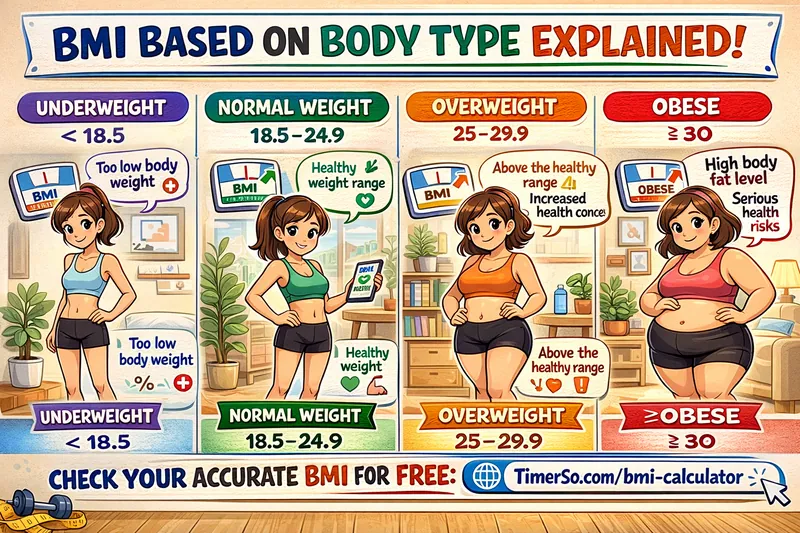
For generations, the Body Mass Index (BMI) has been the go-to metric for doctors, insurance companies, and fitness professionals to quickly assess health. But if you have ever felt that your BMI score doesn't accurately reflect the reality of your physique, you are not alone.
The human body is incredibly diverse. We are not all built with the same bone structure, muscle density, or metabolic rate. This brings up a critical flaw in traditional health screenings: the standard BMI formula does not account for different body types.
In this comprehensive guide, we will explore the science of somatotypes (body types), explain exactly why BMI often misclassifies certain builds, and show you how to better understand your body composition.
The Standard BMI Baseline
Before diving into body types, it is important to understand what BMI actually is. The formula divides your weight in kilograms by your height in meters squared.
The World Health Organization (WHO) categorizes the results as follows: * Underweight: Below 18.5 * Healthy Weight: 18.5 – 24.9 * Overweight: 25.0 – 29.9 * Obesity: 30.0 and above
To establish your starting point, it is helpful to use a reliable tool to check your current BMI. By inputting your data into a free calculator like timerso.com, you can see where you land on the standard medical scale before applying the context of your specific body type.
The 3 Primary Body Types (Somatotypes)
In the 1940s, psychologist William Sheldon introduced the concept of "somatotypes" to categorize the human physique into three broad categories. While modern exercise science recognizes that most people are a blend of these types, understanding the dominant categories explains why BMI can be so misleading.
1. The Ectomorph: Naturally Lean
Ectomorphs are characterized by a slender frame, long limbs, narrow shoulders, and a fast metabolism. They often struggle to gain both weight and muscle mass. * How BMI misreads them: An ectomorph might easily fall into the "Healthy Weight" BMI category simply because they are light. However, without adequate strength training, they can develop "normal-weight obesity" (often called "skinny fat"). This occurs when someone has a healthy BMI but a dangerously high percentage of visceral body fat and very little lean muscle, masking underlying metabolic risks.
2. The Mesomorph: Naturally Athletic
Mesomorphs have a medium-to-large bone structure, broad shoulders, and a natural propensity to build and maintain muscle mass easily. They are genetically primed for strength and athletic power. * How BMI misreads them: This is where the BMI formula fails most spectacularly. Because muscle tissue is roughly 18% denser than fat tissue by volume, a fit mesomorph carries a lot of heavy weight on a compact frame. It is incredibly common for lean, highly conditioned mesomorphs to be classified as "Overweight" or even "Obese" on a standard BMI chart, leading to unnecessary medical anxiety.
3. The Endomorph: Naturally Stocky
Endomorphs generally have a larger bone structure, wider hips, and carry more overall body mass. They tend to gain fat easily and have a harder time losing it due to a generally slower metabolic rate, but they also build lower-body strength very effectively. * How BMI misreads them: Endomorphs are frequently categorized in the upper "Overweight" or "Obesity" ranges. While they may carry a higher body fat percentage, they also carry a significant amount of heavy lean mass and larger, denser bones. A strict BMI reading often overestimates their metabolic risk without accounting for their naturally robust frame.
Why Body Composition Matters More Than BMI
The core issue with interpreting BMI based on body type is the "density dilemma." The mathematical formula treats all weight exactly the same—it cannot distinguish between five pounds of dense skeletal muscle and five pounds of subcutaneous fat.
If your body type naturally leans toward being heavily muscled (mesomorph) or heavily boned (endomorph), the scale will punish you. If you are naturally thin but metabolically unhealthy (ectomorph), the scale will give you a false sense of security.
Better Metrics for Your Body Type
Once you have used a tool to check your current BMI to get your baseline screening, you should pair that number with metrics that actually account for your body composition:
- Body Fat Percentage: This distinguishes lean mass from fat mass. Elite female mesomorphs might sit at 18% body fat, while an ectomorph might sit at 30%, even if they share the exact same BMI.
- Waist Circumference: The best at-home indicator of dangerous visceral fat. For non-pregnant women, a waist measuring over 35 inches (and for men, over 40 inches) suggests a higher risk of metabolic disease, regardless of body type or BMI.
- Waist-to-Hip Ratio: By dividing your waist measurement by your hip measurement, you can see how your body distributes fat, which is highly influenced by your somatotype.
Conclusion
Your body type is heavily influenced by your genetics, and no single math equation can capture the nuances of human biology. While checking your BMI is a valuable first step in understanding your general health, it should never be the final word. Embrace the strengths of your natural build, focus on your body composition, and prioritize how your body performs over what a generalized chart says.
Authoritative References for Further Reading (E.E.A.T)
To ensure your fitness and health strategies are rooted in scientific evidence, consult these authoritative resources:
- American College of Sports Medicine (ACSM): Offers extensive research on how different body types (somatotypes) respond to various exercise modalities and nutritional interventions. (acsm.org)
- Centers for Disease Control and Prevention (CDC): Acknowledges the clinical limitations of BMI, specifically noting that variations in bone structure, muscle mass, and age can skew results. (cdc.gov)
- National Institutes of Health (NIH): Features peer-reviewed studies on "normal-weight obesity" (the skinny-fat phenomenon) and the critical difference between BMI and body fat percentage. (nih.gov)
- World Health Organization (WHO): Provides the standard global definitions of BMI while advocating for combined anthropometric measurements (like waist circumference) to accurately assess metabolic risk. (who.int)
(Disclaimer: This article is intended for educational and informational purposes only and does not constitute medical advice. Body composition and health risks vary greatly by individual. Always consult with a licensed physician, sports medicine professional, or registered dietitian for a personalized health assessment.)