The Muscle Myth: How Accurate is BMI for Athletes?
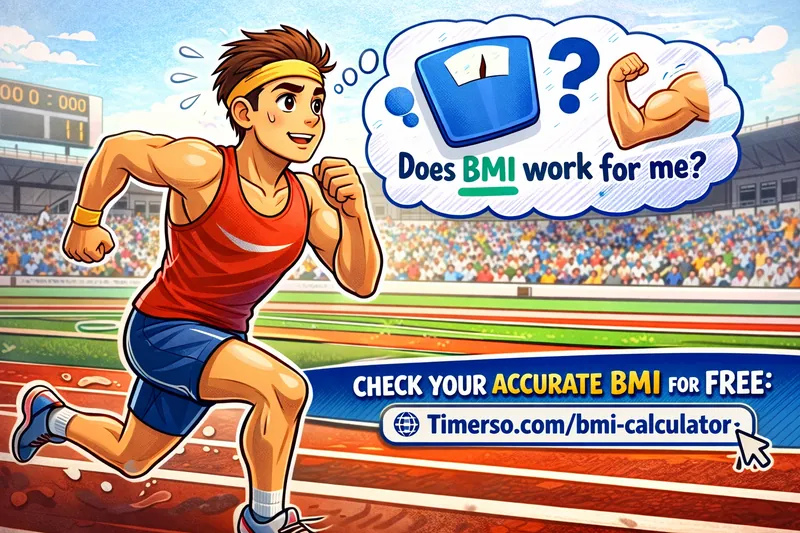
If you are a dedicated athlete, a weightlifter, or simply someone who spends a significant amount of time building muscle, you have likely experienced the frustration of stepping into a doctor's office and being told your Body Mass Index (BMI) is too high.
It is a common scenario: a sprinter in peak cardiovascular health or a rugby player with a visibly low body fat percentage steps on the scale, only to be categorized by the BMI chart as "overweight" or even "obese."
This discrepancy leads to a highly debated question in sports medicine and nutrition: How accurate is BMI for athletes? The short answer is: not very. To understand why this standard medical tool fails those with high athletic performance, we must look at the science behind the formula, the biological differences between muscle and fat, and the alternative metrics athletes should be using instead.
What BMI Actually Measures (And What It Misses)
Body Mass Index was created in the 1830s by a Belgian mathematician named Lambert Adolphe Jacques Quetelet. It was designed to study populations, not individual health. The formula is incredibly simple: it divides your weight in kilograms by your height in meters squared ($kg/m^2$).
The fundamental flaw of BMI when applied to athletes is that it measures excess weight, not excess body fat.
The mathematical formula is completely blind to body composition. It cannot distinguish between: * Bone density * Water weight * Adiposity (fat tissue) * Skeletal muscle mass
The Density Dilemma: Muscle vs. Fat
The primary reason athletes skew the BMI chart is due to tissue density. By volume, muscle is roughly 18% denser than fat.
This means that one pound of muscle takes up significantly less space in the body than one pound of fat. Therefore, an athlete who engages in rigorous resistance training or high-intensity sports will build dense, heavy muscle mass.
Consider this example: * Person A is a sedentary office worker who is 6 feet tall, weighs 220 pounds, and has a body fat percentage of 30%. * Person B is a professional linebacker who is 6 feet tall, weighs 220 pounds, and has a body fat percentage of 10%.
According to a standard BMI chart, both individuals have a BMI of 29.8, placing them just 0.2 points away from clinical obesity. However, Person B is in elite cardiovascular and metabolic shape, while Person A is at a high risk for metabolic syndrome.
For the athlete, the BMI categorization is not just inaccurate; it is clinically irrelevant.
Better Metrics for Athletic Populations
Because BMI cannot distinguish between a highly conditioned athlete and a sedentary individual with high adiposity, sports medicine professionals rely on advanced body composition metrics to assess an athlete's health and performance.
If you are highly active, you should track these metrics instead of your BMI:
- Body Fat Percentage: This is the most critical metric for athletes. It measures the exact proportion of fat to lean tissue. Elite male athletes typically sit between 6% and 13%, while elite female athletes range from 14% to 20%.
- DEXA Scans (Dual-Energy X-ray Absorptiometry): The gold standard in sports medicine. It uses low-level X-rays to provide a highly accurate breakdown of bone density, fat mass, and muscle mass.
- Waist-to-Hip Ratio (WHR): A simple tape measure test that assesses visceral fat (the dangerous fat stored around abdominal organs). A healthy WHR is a better predictor of cardiovascular health than BMI.
- Skinfold Calipers: When used by a trained professional, calipers measure the thickness of subcutaneous fat at various points on the body to estimate overall body fat percentage.
When is BMI Still Useful?
While athletes should look beyond the standard chart, it is important to note that BMI is not entirely useless. For the vast majority of the non-athletic population, BMI remains a fast, free, and statistically reliable screening tool for identifying potential metabolic health risks.
If you are just beginning your fitness journey, have not yet built a significant amount of muscle mass, or are looking for a baseline health screening, using a tool to check if your BMI is healthy is still a valid and recommended first step. By utilizing tools like the one at timerso.com, you can establish a starting point before you begin altering your body composition through diet and exercise.
Conclusion
If you train hard, lift weights, or compete in sports, do not let a high BMI discourage you. The BMI scale was designed for population-level statistics, not for assessing the finely-tuned physiques of athletes. Focus your attention on your performance, your body fat percentage, and how you feel, rather than a 200-year-old mathematical ratio.
Authoritative References for Further Reading (E.E.A.T)
To ensure your training and health assessments align with modern sports science, consult these trusted, peer-reviewed resources:
- American College of Sports Medicine (ACSM): Provides comprehensive guidelines on body composition, athletic performance, and why traditional BMI fails athletic populations. (acsm.org)
- Centers for Disease Control and Prevention (CDC): Acknowledges the limitations of BMI, specifically noting that highly trained athletes may have a high BMI because of increased muscularity rather than increased body fatness. (cdc.gov)
- National Institutes of Health (NIH): Features numerous clinical studies comparing the efficacy of BMI versus DEXA scans and skinfold measurements in athletic cohorts. (nih.gov)
- International Society of Sports Nutrition (ISSN): Offers evidence-based position stands on diets and body composition metrics for athletes. (sportsnutritionsociety.org)
(Disclaimer: This article is intended for educational and informational purposes only and does not constitute medical advice. Always consult with a sports medicine physician or a registered dietitian for personalized assessments of your body composition and athletic health.)